History

The Horned Sea

Literary historical fiction in five novels about the working people of the Bronze Age Aegean: painters, divers, midwives, dyers, smiths, scribes’ clay-hands and oarsmen, from the painted towns of Crete to the open sea after the last palaces fell.

Crete, Thera, Millawanda, Pylos, Tiryns, Cyprus, Ugarit & the Southern Levant · c. 1628–1177 BCE · 16+ · Floor 16+ · Recommended 18+

New here? Start with Chapter 1 of Book I, The Stone That Drinks, free in the Reading Room: a bull-leaper running from a vow, and the four working lives on Crete and the Round Island that his running pulls together. Then visit the Atelier for the paintings, the Scripts Studio to see and hear the writing of the age (Minoan Linear A is shown but never voiced, because no one can yet read it), and the Evidence Ledger to check what is attested, what is disputed and what we invented.

The five spines join into one continuous painting when shelved together: 1,366 pages across 302 / 254 / 238 / 254 / 318 pages, 78.1 mm of shelf. Switch between flush and parted spines.

Painted Lime, Sealed Honey, Wet Clay, and Five Lives of the Bronze Age Sea

The Horned Sea follows ordinary working people across more than four centuries of the Bronze Age Aegean. Book I belongs to Crete and the Round Island in the years before the great eruption, long before any Greek reached the island. Book II moves on several generations, to the fires that burned the Cretan towns and the mainland lords who took Knossos and began writing Greek in the old Cretan signs. Books III to V follow one family and its neighbours across some sixty years: from a dyers’ lane in Millawanda on the Anatolian coast, through the last spring of the palace at Pylos, to the open eastern sea after the palaces were gone.

The Eruption and the Fall of Crete Were Generations Apart

Stratigraphy and radiocarbon separate Book I’s world on Crete and the Round Island — where Akrotiri’s inhabitants departed by sea before the eruption, leaving no skeletons in the pumice — by two to four human generations from the selective fires of Book II that burned the rival Cretan towns while sparing central Knossos.

Minoan Writing Stays Unread

Minoan Linear A has never been deciphered. The novels show only what can honestly be shown: signs for goods, fractions, place-names, totals, and the libation phrase a-sa-sa-ra-me, which is heard but never translated. No one in the books speaks a reconstructed Minoan sentence, and this site offers no Minoan audio.

Clay Accounts, Not Chronicles

Linear B tablets were sun-dried clay accounts kept for the current year, then reworked or thrown away. They survive only where a palace burned hot enough to fire them. Nobody wrote poems or histories on them; songs and memory stayed spoken. Fingerprints left by the people who prepared the clay survive on some tablets, and the novels give those hands lives.

An Erased King and an Open Sea

Around 1225 BCE a Hittite scribe drafting a treaty smoothed the words ‘and the King of Ahhiyawa’ out of a list of great kings while the clay was still soft (AhT 2, §13′). A generation later the palace at Pylos burned. The movements by sea that followed appear in Book V as loose crews and households of many origins, not as one invading empire.

Clay, Glyptic & Stratigraphic Labs

Book I Material & Seal Profiles (Late Minoan IA)

Working objects from Book I (The Stone That Drinks): Cretan carnelian wild-goat wrist-seal and Mallia gold acrobat sword-pommel, single right-hand corded boxing glove beside a bare parrying palm, Amnisos cave stalagmite honey-jar, and Akrotiri grooved stone pounder beside pumice bed-casts.

The Wet-Clay, Seal & Erasure Desk

Interactive raking-light CTH 105 clay erasure viewer (tilting from flat overhead light to grazing lamp light over AhT 2, §13′, Book III), Pylos PY Ep 704 front, palm-printed back, and Room 7 Fragment 619 viewer (Book IV), and Minoan Linear A accounting vs undeciphered speech comparator (Books I–II).

Three Archaeological Horizons: Pumice, Cretan Fires & Pylos Clay

Interactive 20 °C to 1,050 °C thermal scrubber contrasting Late Minoan IA Akrotiri cold pumice burial, Late Minoan IB Cretan town fires sparing central Knossos generations later, and the oil-fed fire at Pylos that baked unbaked clay tablets hard, paired with two-sided scholar debate cards.

Volumes

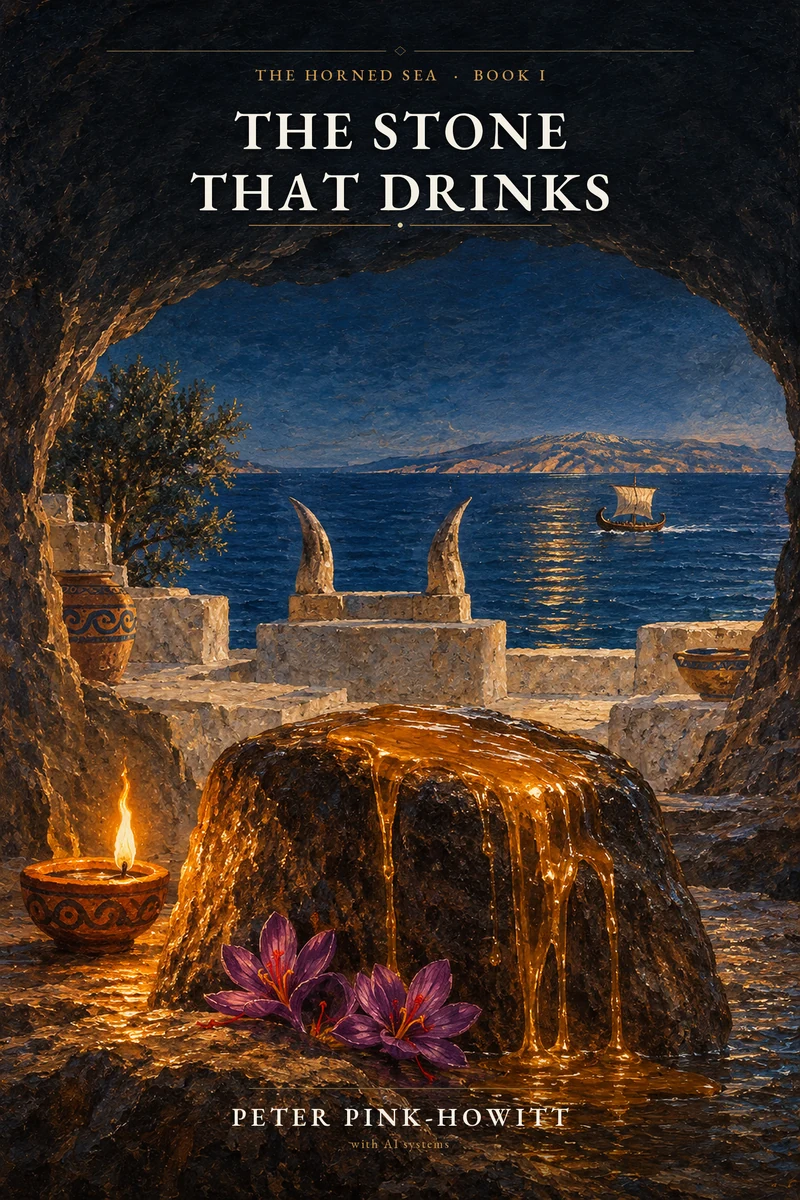
Cover for Book I: The Stone That Drinks

Book I: The Stone That Drinks 16+

Volume I (Late Minoan IA, c. 1610–1525 BCE, disputed · Crete and the Round Island · 302 pages). Years ago, in a river-mouth cave on Crete, a midwife saved a mother’s life with a vow: a child of that womb for the Lady’s court. Now the son is a bull-leaper in gold, and when his partner is gored he runs, out across the water to a ship bound for the Round Island, where a young murex diver hauls him aboard by the hair. The island says a life pulled from the sea belongs to the house that pulled it. Crete says the vow must be paid, by the boy or by his younger sister. A wall-painter, a diver, a midwife and a shepherd carry the quarrel across one year on two islands, while the ground under the Round Island begins to stir.
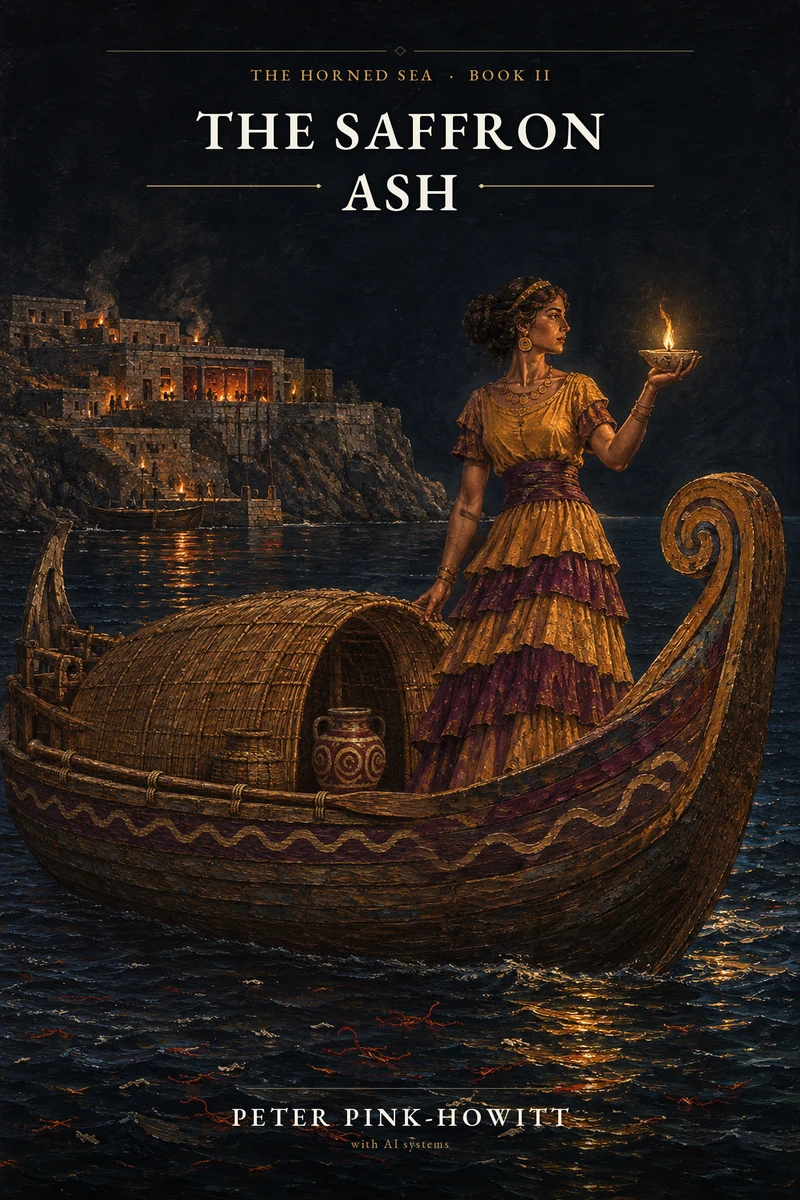
Cover for Book II: The Saffron Ash

Book II: The Saffron Ash 16+

Volume II (c. 1455–1435 BCE · Crete · 254 pages). Several generations after the Round Island was abandoned, fires burn the towns and great houses of Crete while Knossos stands. Mainland lords take the court, and their clerks begin writing Greek in the old Cretan signs. Across twenty years four people live by the count: Tukhana, who seals saffron and copper in the eastern palace at Zakros; Widamata, a dye-vat hand who learns to flatten clay for the new scribes; Klumenos, a mainland chariot officer who will not act on one man’s word; and Alasios, a harbour pilot who always knows the way out to sea.

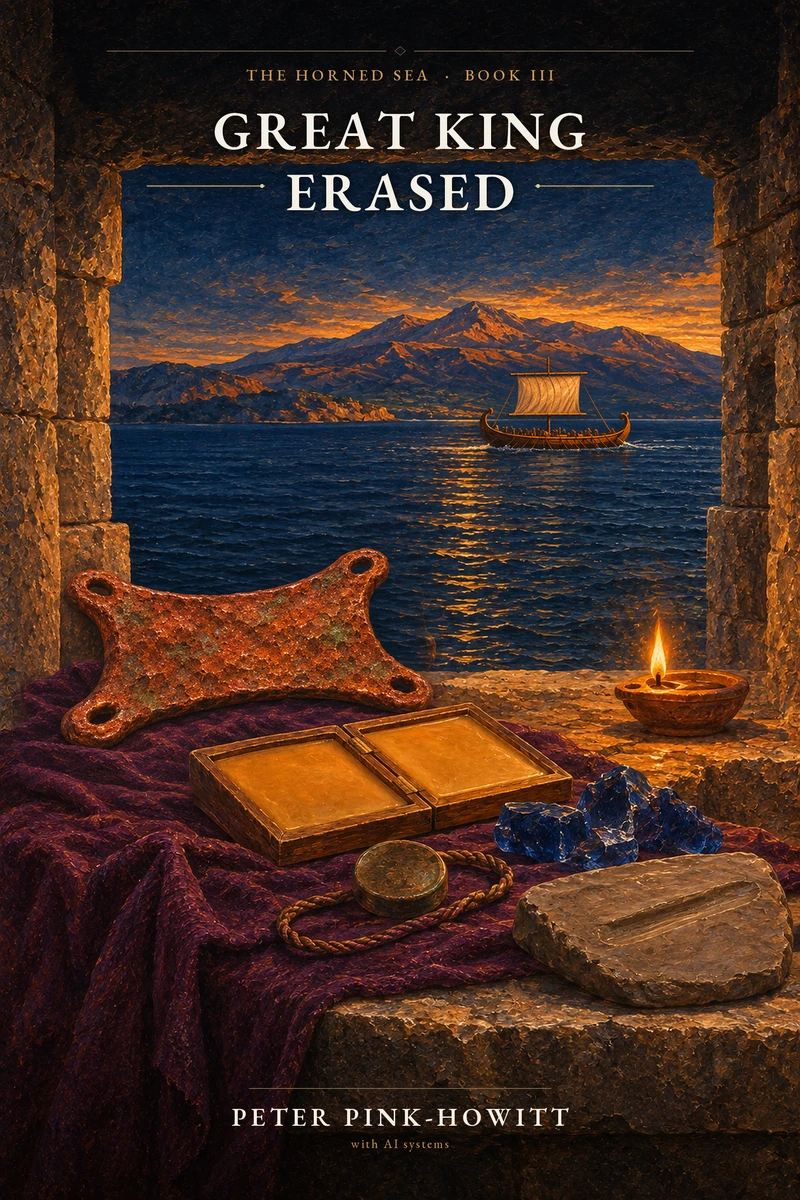
Cover for Book III: Great King Erased

Book III: Great King Erased 16+

Volume III (c. 1240–1225 BCE · Millawanda, Hattusa and Pu-ro · 238 pages). In the dyers’ lane of Millawanda, on the Anatolian coast, Risura’s house pays an extra bale of wool every New Year so that its daughters are never written on anyone’s clay. Over fifteen years the great powers redraw the town around her: the Hittite king’s men come through the gate, a renegade prince slips away by night with captives under his rowing benches, and a seal-keeper named Zamnawiya watches a scribe in Hattusa smooth a king out of a treaty while the clay is still wet. Across the sea at Pu-ro a village smith, Dautaros, weighs the palace’s bronze, and between the two coasts a fifty-oar mate, Loukos, carries whatever pays.

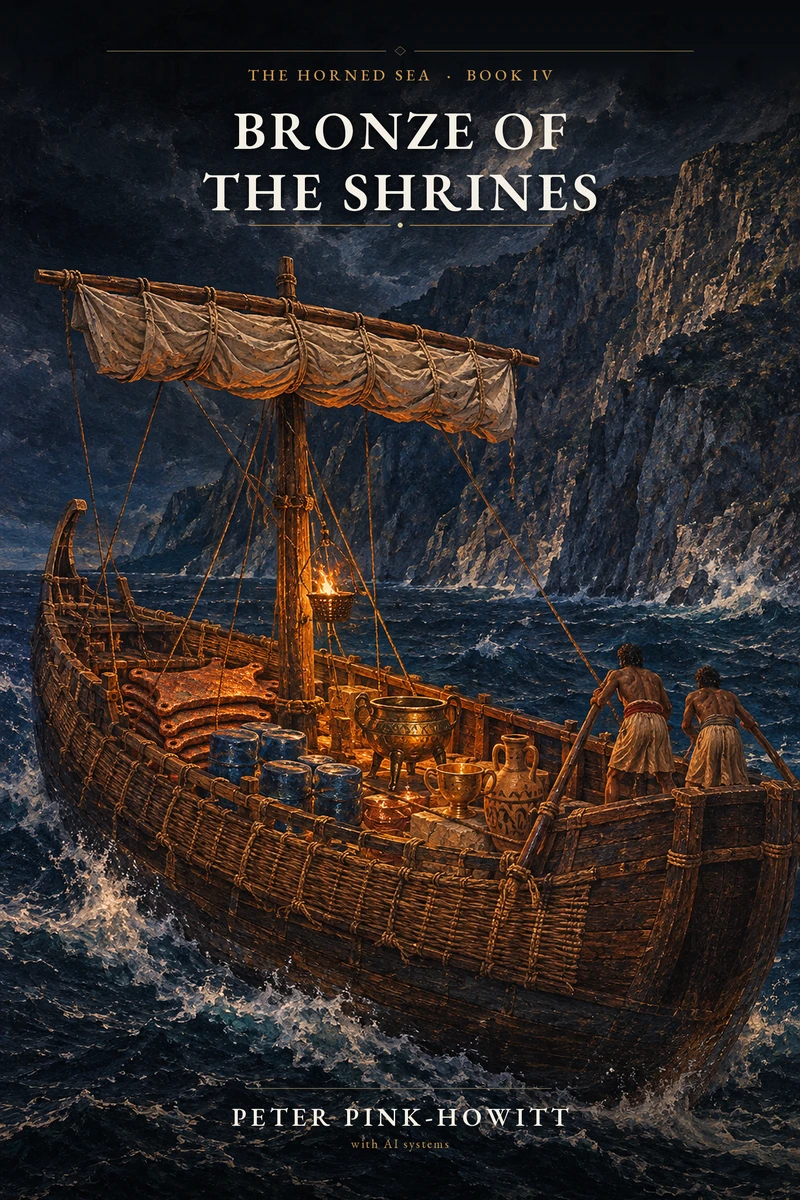
Cover for Book IV: Bronze of the Shrines

Book IV: Bronze of the Shrines 16+

Volume IV (c. 1203 BCE · Pu-ro and its coast · 254 pages). The last spring of the palace at Pu-ro, the place now called Pylos. Risura, fifty-one and the senior woman of the weaving shed, lies about her granddaughter’s age to keep the girl off the palace’s lists. Zamnawiya keeps the wax boards of the shrine at Pa-ki-ja-ne and strikes the bargain that sends its bronze to the palace crucibles. Dautaros, a smith with no tin, takes a hammer to the votive tripod his village has known all its life. Loukos, master of a fifty-oar, fills his empty benches with weavers’ sons for a coast that cannot be guarded. The tablets the palace writes that season are the only year of the kingdom anyone can still read.

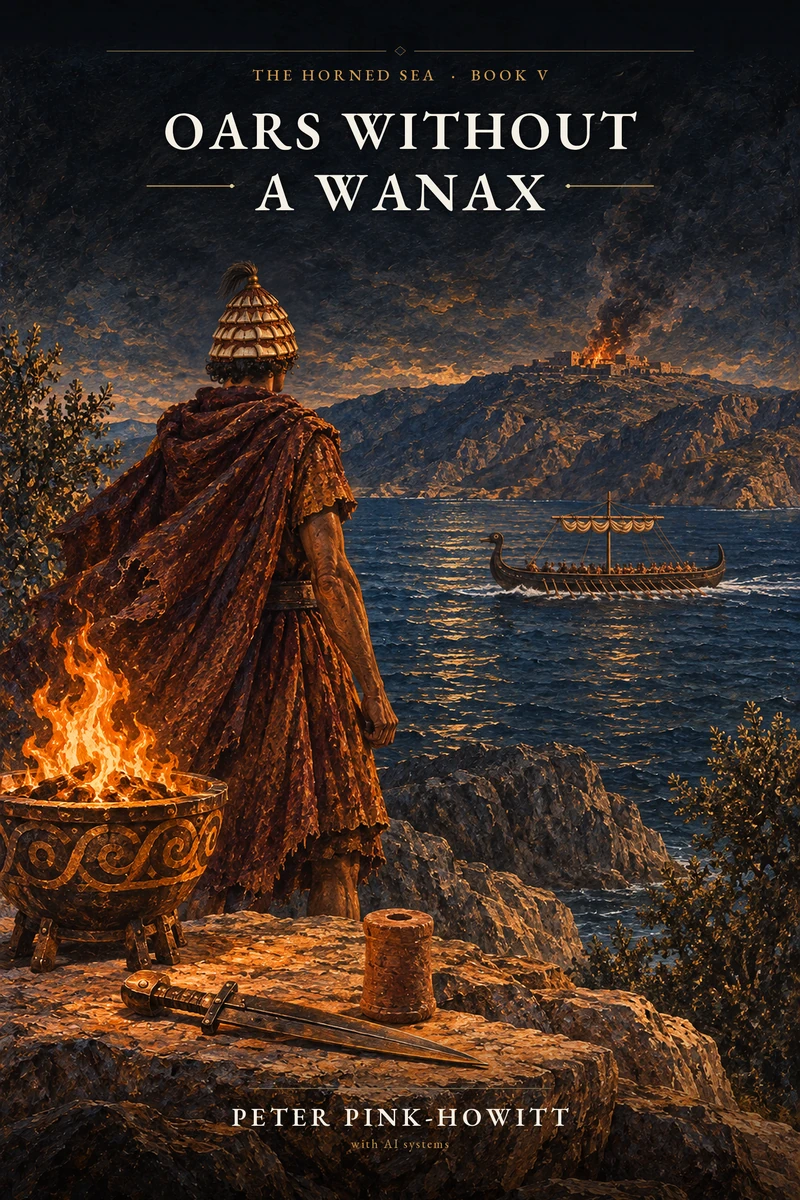
Cover for Book V: Oars Without a Wanax

Book V: Oars Without a Wanax 16+

Volume V (c. 1203–1177 BCE · Tiryns, Lukka, Alashiya, Ugarit and the Southern Levant · 318 pages). Thirteen springs after the palace at Pu-ro burned, refugees who have made a life in the lower town at Tiryns, below a narrower hall raised where the throne once stood, put their households aboard one fifty-oar hull and row east for whoever will feed them: a Hittite envoy in Lukka waiting on a short-weight cargo, the smiths of Alashiya who have learned to work black iron, the ash of Ugarit, and a walled town on the southern coast, modelled on Ashkelon, where a household of strangers learns to bake in someone else’s oven. There is no king, no scribe and no ration to come home to. What the crew keeps is a count of shares, a few seals and weights, and what they can remember.

Chronology & Story Scrubber

Late Minoan IA (c. 1610–1525 BCE, disputed), Spring Sailing Opening — Wet-lime fresco workshops paint saffron crocus and blue reeds on Cycladic and Cretan walls while single-glove youth boxing, bull-leaping courts, Amnisos stalagmite honey offerings, and seasonal upland sheep transhumance bind island households before Greek reached Crete. · Aresana, Kupanu, Midamara and Teyare cross paths between the Round Island, the bull-court of north Crete, the birth-cave at the river mouth and the high pastures of Ida (Book I: The Stone That Drinks).
c. 1455–1435 BCE (Cretan Town Fires & Knossos Chariot Tablets) Book II horizon · Opens after Book I

Several generations after the sea departure from Akrotiri, selective fires burn Zakros, Hagia Triada, Phaistos, and Mochlos while sparing central Knossos, where clerks in the Room of the Chariot Tablets adapt Cretan signs to record Greek chariots and armour in Linear B. · Across Zakros, Kommos, and spared Knossos, Cretan seal-keepers, dye-vat hands, harbour pilots, and mainland chariot officers live through the change of masters and scripts (Book II: The Saffron Ash).

c. 1240–1225 BCE (Millawanda between Hatti, Mira and Ahhiyawa) Book III horizon · Opens after Book II

Tudhaliya IV of Hatti and Tarkasnawa of Mira end the Ahhiyawan foothold at Millawanda; in the Shaushgamuwa Treaty (CTH 105 / AhT 2, §13′), a Hittite royal scribe writes ‘and the King of the land of Ahhiyawa’ beside Egypt, Babylonia, and Assyria, then smooths the title out of the damp clay. · A dyers’ house in Millawanda keeps its daughters off the clay while Hatti, Mira and the mainland bargain over the town, and a fifty-oar mate carries captives, letters and cargo between the coasts (Book III: Great King Erased).

c. 1203 BCE, the Month of Sailing (Pylos tablets Ep 704, An 657, Jn 829, Tn 316) Book IV horizon · Opens after Book III

At Pylos the priestess Eritha disputes the status of her land with the village assembly (Ep 704), the palace posts watchers along the coast (An 657), collects temple bronze for points and spears (Jn 829), and records gold vessels and people sent to the shrines (Tn 316, a tablet whose meaning is still argued). · A weaving shed, a shrine’s store, a smith’s forge and a half-crewed fifty-oar live through the palace’s last season (Book IV: Bronze of the Shrines).

c. 1203–1177 BCE (Tiryns, Lukka, Enkomi, Ugarit and the southern coast) Book V horizon · Opens after Book IV

Survivors at Tiryns build a narrower hall, Building T, over the old throne room; a Hittite envoy, Satalli, waits in Lukka on a disputed cargo (RS 94.2523, read as ingots or as provisions); smiths at Enkomi work black iron; Ugarit burns; and newcomers settle beside the old towns of the southern Levant. · Oar-bench, forge, and loom households outliving the vanished clay-tablet kingdoms across an open eastern sea (Book V: Oars Without a Wanax).